Clinical Research

Research, woven into care.Operations, automated underneath it.

Plexus connects sponsors, CROs, community clinics, investigators, and patients through one clinical trial operating platform.

We help practices become research sites, help sponsors and CROs reach patients outside traditional research centers, and automate the operational work required to move a trial from protocol to completion.

Research does not need to sit outside the practice. Plexus brings it onto the clinic floor.

The Ecosystem

One platform. Three sides of the research ecosystem.

Clinical research works when the right study reaches the right site, the right patient is identified, and every step that follows is executed correctly. Plexus connects each part of that system.

Reach community patients through sites built to perform.

Plexus gives sponsors access to community practices with established patient populations while providing the infrastructure, technology, and operational oversight required to execute trials consistently.

Plexus helps sponsors

  • Identify high-potential community sites
  • Evaluate patient populations before site activation
  • Forecast enrollment opportunity
  • Reduce non-enrolling sites
  • Accelerate recruitment and randomization
  • Monitor enrollment against target
  • Compare site performance
  • Surface operational risks earlier
  • Improve visibility across the study lifecycle
  • Track financial and operational performance in one place

Bring your next study closer to the patients who need it.

The Clinical Trial Operating Layer

From protocol to closeout, the workflow runs through Plexus.

Clinical trials are often managed across spreadsheets, inboxes, sponsor portals, disconnected software, manual checklists, and individual staff members. Plexus brings those workflows into one operating environment.

At every stage of the trial, the platform helps determine what needs to happen next, what is approaching a deadline, what has stalled, and where intervention is required.

01 · Study Feasibility

Know whether the site can perform before the study begins.

Plexus evaluates protocol requirements against available patient populations, clinic characteristics, specialty, provider capacity, and operational readiness.

The goal is not simply to activate more sites. It is to activate the right sites.

Automated through Plexus

  • Protocol criteria extraction
  • Structured feasibility workflows
  • Patient population analysis
  • Inclusion and exclusion criteria mapping
  • Estimated eligible patient pool
  • Site capability assessment
  • Enrollment forecasting
  • Study-to-site matching

What this improves

  • Feasibility response time
  • Site selection quality
  • Enrollment predictability
  • Percentage of activated sites that enroll
  • Time from opportunity to decision
02 · Site Startup

Turn an ordinary clinic into a research-ready site.

Once a study is awarded, Plexus coordinates the operational work required to activate the site.

Regulatory documentation, training, responsibilities, startup tasks, and milestones are organized into a standardized workflow.

Automated through Plexus

  • Startup task generation
  • Regulatory document tracking
  • Training assignment
  • Training completion monitoring
  • Missing-document detection
  • Document expiration alerts
  • Site readiness dashboards
  • Activation milestone tracking

What this improves

  • Days from award to activation
  • Regulatory turnaround time
  • Training completion
  • Startup deficiencies
  • Activation predictability
03 · Patient Identification

The next trial participant may already be sitting in the clinic.

Plexus IQ helps evaluate available clinical information against active trial criteria and surfaces potentially eligible patients for research staff review.

Instead of beginning recruitment with a cold audience, the site can begin with patients already connected to the practice.

Automated through Plexus

  • Inclusion and exclusion criteria matching
  • Diagnosis screening
  • Medication matching
  • Laboratory matching
  • Medical history screening
  • Candidate prioritization
  • Visit-based candidate identification
  • Screening queue generation
  • Duplicate screening prevention

What this improves

  • Eligible patients identified
  • Patient identification speed
  • Recruitment efficiency
  • Screen-to-contact conversion
  • Cost of recruitment
04 · Recruitment

Turn patient identification into a managed enrollment funnel.

Finding a patient is only the beginning.

Plexus creates a structured recruitment workflow around every potential participant so research teams can see who has been identified, contacted, screened, enrolled, declined, or stalled.

Automated through Plexus

  • Recruitment worklists
  • Outreach task creation
  • Contact attempt tracking
  • Follow-up reminders
  • Candidate status progression
  • Recruitment funnel analytics
  • Stalled candidate detection

What this improves

  • Contact rate
  • Response rate
  • Screening rate
  • Enrollment conversion
  • Time from identification to consent
  • Enrollment velocity
05 · Screening & Enrollment

Keep every candidate moving toward a clear outcome.

Plexus guides the screening workflow and makes missing or incomplete steps visible before they delay enrollment.

Automated through Plexus

  • Eligibility workflows
  • Screening checklists
  • Required assessment tracking
  • Screening window alerts
  • Study milestone tracking
  • Enrollment readiness
  • Screen failure categorization
  • Randomization tracking

What this improves

  • Screen failure rate
  • Screening completion time
  • Consent-to-randomization rate
  • Randomization velocity
  • Enrollment against target
06 · Trial Visits

Turn the protocol into an operational workflow.

Every participant follows a defined schedule.

Plexus translates that schedule into tasks, visit windows, required procedures, and alerts so the research team knows what must happen and when.

Automated through Plexus

  • Protocol visit schedules
  • Visit window calculations
  • Upcoming visit queues
  • Procedure checklists
  • Missed-step alerts
  • Participant milestone tracking
  • Overdue activity detection

What this improves

  • Visit window compliance
  • Missed visit rate
  • Protocol deviation rate
  • Participant completion
  • Site workload visibility
07 · Data & Quality Oversight

See research problems before they become monitoring findings.

Trial performance should not become visible only when a monitor arrives.

Plexus continuously surfaces incomplete workflows, missing information, unresolved items, and operational exceptions.

Automated through Plexus

  • Missing-data detection
  • Incomplete workflow alerts
  • Exception queues
  • Open-item tracking
  • Site performance monitoring
  • Escalation workflows
  • Cross-site comparison

What this improves

  • Data completeness
  • Query burden
  • Query resolution time
  • Protocol deviations
  • Outstanding action items
  • Monitoring readiness
08 · Safety & Compliance

Keep safety obligations visible and moving.

Safety events and compliance responsibilities should not depend on memory or disconnected email chains.

Plexus creates structured workflows around reporting, follow-up, documentation, deadlines, and escalation.

Automated through Plexus

  • Safety workflow initiation
  • Follow-up task assignment
  • Reporting deadline tracking
  • Documentation completeness checks
  • Escalation alerts
  • Activity history
  • Compliance tracking

What this improves

  • Reporting timeliness
  • Outstanding safety items
  • Documentation completeness
  • Compliance completion
  • Audit readiness
09 · Financial Intelligence

Know what the study earned, what was billed, and what is still missing.

Clinical research creates financial activity at every stage of participant progression.

Plexus connects study activity to sponsor obligations so sites can see what has been earned, what remains unbilled, what is outstanding, and how each study is performing financially.

Automated through Plexus

  • Visit and milestone reconciliation
  • Earned revenue tracking
  • Unbilled activity detection
  • Invoice readiness
  • Sponsor receivable tracking
  • Payment status monitoring
  • Study-level financial reporting

What this improves

  • Revenue captured
  • Unbilled revenue
  • Days to payment
  • Accounts receivable aging
  • Revenue per participant
  • Study profitability
10 · Study Closeout

Finish the study with the same structure used to run it.

Plexus organizes remaining participant, regulatory, financial, and operational obligations into a single closeout workflow.

Automated through Plexus

  • Closeout task generation
  • Outstanding item detection
  • Document reconciliation
  • Financial reconciliation
  • Final action tracking
  • Completion dashboards

What this improves

  • Time to closeout
  • Outstanding closeout items
  • Unresolved financial balances
  • Documentation completeness

Clinical Research Intelligence

All trials, on one screen.

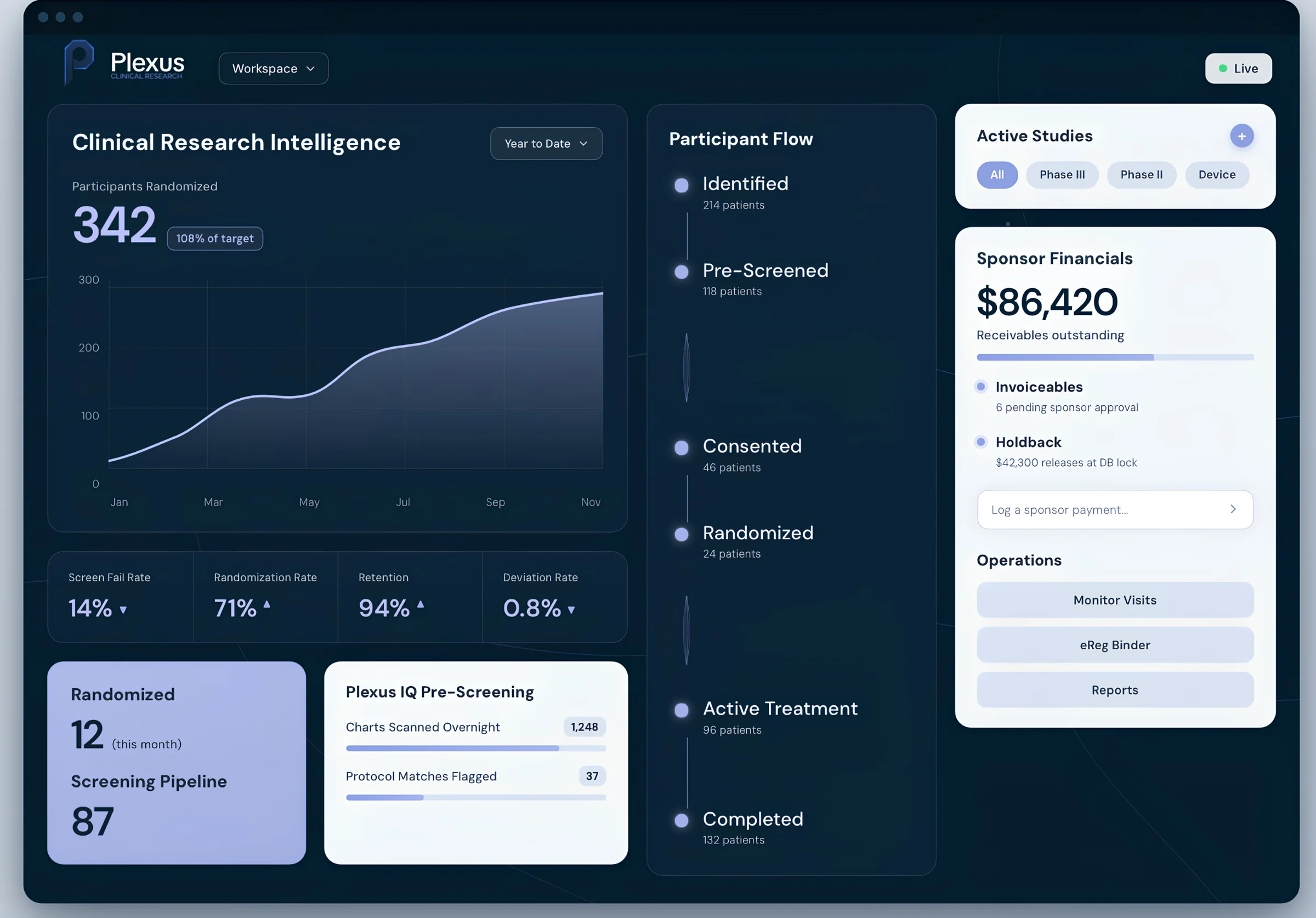
Clinical Research Intelligence is the command center behind the Plexus research network. It gives sponsors, CROs, clinics, investigators, and research leadership a live view of how studies are actually performing.

Not just what happened. What is happening now. And what requires attention next.

Plexus Clinical Research Intelligence dashboard showing participants randomized against target, participant flow from identified through completed, sponsor financials, and Plexus IQ pre-screening
Clinical Research Intelligence  ·  the clinical trial operating platform

Enrollment

  • Eligible patient population
  • Patients identified
  • Patients contacted
  • Patients screened
  • Participants randomized
  • Enrollment against target
  • Enrollment velocity
  • Screen failure rate
  • Conversion through the recruitment funnel

Operations

  • Site activation time
  • Upcoming participant visits
  • Visits overdue
  • Tasks outstanding
  • Enrollment by site
  • Participant retention
  • Site workload
  • Site performance

Quality

  • Protocol deviations
  • Missing data
  • Open queries
  • Query resolution time
  • Safety items
  • Regulatory status
  • Documentation completeness
  • Monitoring readiness

Financial

  • Earned revenue
  • Billed revenue
  • Unbilled activity
  • Sponsor receivables
  • Collections
  • Revenue per participant
  • Revenue by study
  • Study profitability

Levels

One platform. Three levels of intelligence.

Level I

Participant

  • Where is this participant in the trial?
  • What has been completed?
  • What comes next?
  • What is overdue?
Level II

Study

  • Are we on target?
  • Where is enrollment slowing?
  • Which operational items require intervention?
  • How is the study performing clinically, operationally, and financially?
Level III

Network

  • Which sites are performing?
  • Which sites are falling behind?
  • Where are the strongest patient populations?
  • Where should the next study be placed?

Plexus IQ

Intelligence embedded throughout the trial.

Plexus IQ is not a separate tool sitting beside the research workflow. It is the intelligence layer running through it.

Protocol Intelligence

Turn protocol requirements into structured criteria, workflows, operational milestones, and site requirements.

Patient Intelligence

Match patient populations against active study criteria and prioritize candidates for research review.

Recruitment Intelligence

Identify where candidates are dropping out of the enrollment funnel and which patients require action.

Operational Intelligence

Surface overdue tasks, missed milestones, stalled participants, site risks, and areas requiring intervention.

Performance Intelligence

Understand why a site or study is above or below target.

Financial Intelligence

Identify missing billable activity, outstanding sponsor payments, and potential research revenue leakage.

For Sponsors

Bring trials closer to community patients.

Many patients who could participate in clinical research never encounter a study because the practices caring for them are outside the traditional research infrastructure. Plexus changes that.

We connect sponsors to community clinics, help determine where qualified patients are likely to exist, build the research infrastructure around those practices, and provide continuous visibility into performance after activation.

Sponsors gain

  • Access to community patient populations
  • Better-informed site selection
  • Enrollment forecasting
  • Faster patient identification
  • Greater enrollment visibility
  • Standardized site operations
  • Earlier identification of underperformance
  • Cross-site analytics
  • Operational transparency
  • Financial visibility

More sites is not the goal. More sites that enroll and execute well is.

For CROs

A scalable operating layer across every participating site.

CROs coordinate increasingly complex studies across sites with very different levels of research maturity. Plexus standardizes the operating environment underneath those sites.

From startup through enrollment, participant flow, quality oversight, and financial tracking, CRO teams can see where a study is moving and where it is not.

CROs gain

  • Faster site activation
  • Standardized workflows
  • Centralized enrollment visibility
  • Recruitment funnel monitoring
  • Site performance comparison
  • Task and milestone oversight
  • Protocol deviation visibility
  • Query tracking
  • Regulatory readiness
  • Earlier intervention

Less time finding problems. More time solving them.

For Clinics

Add clinical research without building a research department.

A community practice should not need to become a dedicated research company to participate in clinical trials. Plexus brings the infrastructure into the practice.

01

We evaluate the opportunity.

We look at the clinic’s specialty, patient population, providers, workflows, space, and research potential to determine where clinical research makes sense.

02

We build the research layer.

Plexus helps establish the regulatory, operational, technological, and staffing infrastructure required to conduct studies.

03

We connect the practice to studies.

The clinic becomes accessible to sponsors and CROs looking for qualified investigators, community sites, and patient populations.

04

We identify potential participants.

Plexus IQ helps find potentially eligible patients within the population the clinic already serves.

05

We manage the workflow.

Research activities are organized around the clinic’s existing operation instead of forcing the clinic to redesign its entire practice.

06

We track the economics.

The clinic can see study activity, earned revenue, sponsor receivables, collections, and financial performance.

The Difference

What changes for the clinic?

Without Plexus

A practice may need to independently manage:

  • Sponsor outreach
  • Study sourcing
  • Feasibility questionnaires
  • Regulatory documentation
  • Training
  • Patient recruitment
  • Screening
  • Participant tracking
  • Protocol schedules
  • Sponsor communication
  • Research technology
  • Financial reconciliation
  • Performance reporting

With Plexus

Those functions operate through one research infrastructure built around the practice.

  • The provider continues practicing medicine
  • The clinic continues seeing patients
  • Research becomes another capability of the organization

The Upside

New revenue. New patient access. New capability.

New Revenue

Clinical research creates an additional line of business using the clinic’s existing patient relationships and clinical infrastructure.

Patient Access

Patients can gain access to investigational therapies and studies without leaving the practice they already trust.

Provider Opportunity

Physicians can participate as investigators without personally building an entire research operation.

Practice Differentiation

The clinic becomes part of the research ecosystem and gains access to opportunities historically concentrated within academic centers and dedicated research sites.

The Connection

The connective layer clinical research has been missing.

Sponsors need patients. CROs need sites that execute. Clinics already care for the patients those studies are trying to reach. Plexus connects them.

Sponsors & CROs Protocols · Studies · Oversight
Plexus Clinical Research Technology · Operations · Intelligence · Research Infrastructure
Community Clinics & Investigators Sites · Providers · Coordinators
Patients Access · Participation · Care

One operating layer connecting the protocol to the site and the site to the patient.

Then & Now

Research infrastructure was fragmented. Plexus connects it.

Traditional Research

  • Separate recruitment systems
  • Manual feasibility
  • Spreadsheet-based screening
  • Email-driven startup
  • Disconnected site workflows
  • Reactive monitoring
  • Manual financial reconciliation
  • Variable site performance
  • Research operating separately from care

With Plexus

  • Integrated recruitment workflows
  • Data-driven feasibility
  • Intelligent patient identification
  • Structured startup automation
  • Standardized operating workflows
  • Continuous performance visibility
  • Integrated financial intelligence
  • Network-wide performance measurement
  • Research woven into the clinical practice

Research, Woven Into Care

Plexus turns community practices into research sites.

We connect those sites to sponsors and CROs, and provide the operating infrastructure required to run clinical trials at scale.

For sponsors, it creates access.

For CROs, it creates control and visibility.

For clinics, it creates a new capability.

For patients, it brings research closer to where care already happens.

Where do you sit in the research ecosystem?